
mass civic innovation lab
The MASS Civic Innovation Lab develops practical innovations that expand the role of citizens in public decision-making. From civic lotteries and reference panels to new ideas like service ballots and civic challenges, our work creates structured opportunities for ordinary people to contribute to complex public choices. The aim is simple: strengthen democratic institutions by making them more participatory, representative, and capable of drawing on the intelligence and experience of the public.
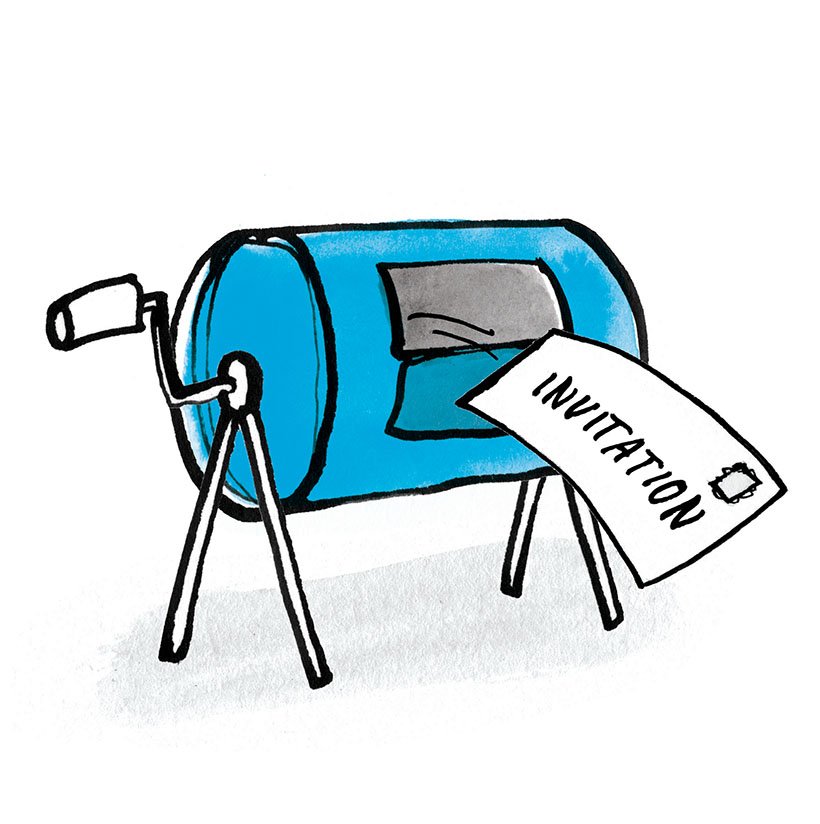
MASS Idea #1: Civic Lotteries
Civic lotteries are a tool used by governments to convene broadly representative groups of citizen volunteers to tackle public policy challenges. The idea is based on an ancient practice called ‘sortition’ which is still used in many countries to randomly select citizens to serve on civil, criminal and coroner’s juries.
Civic lotteries are based on this same practice. But rather than compelling people to serve, as governments do with jury duty, civic lotteries encourage randomly selected recipients to volunteer their time by opting in to the lottery.
In this respect, civic lotteries employ two randomizing filters: firstly, when randomly selected households receive an invitation to volunteer; and second, when participants are randomly selected from the pool of volunteers to broadly match a community’s demographic profile.
MASS has pioneered the use of civic lotteries to address policy challenges, cumulatively sending more than 350,000 invitations to 1 in 38 households across Canada. In doing so, we’ve created opportunities for more than 1,300 randomly selected Canadians to participate in the work of government and serve their communities.
Want to learn more about civic lotteries? Download and read through our Civic Lottery Guide.

MASS Idea #2: Service Ballots
Service ballots, also known as “second ballots”, are a mechanism to give voters a simple and effective way to volunteer their time to serve on a public board, agency or commission, and to provide their advice to government on a specific issue. Offering voters a service ballot can dramatically increase the number of candidates available to fill these roles and improve the diversity of public governance.
Service ballots also send a powerful signal that help to establish a strong participatory culture, underscoring the idea that citizens have an essential role to play between elections in the work of government.
Work is underway to pilot service ballots in various municipalities across Canada in 2026. Learn more here.

MASS Idea #3: Reference Panels
Reference Panels are long-form deliberative processes that typically involve 36 randomly selected residents who meet over three or more days to examine an issue, reach consensus and draft detailed recommendations for public authorities.
Reference Panels are commissioned by government and public agencies with an explicit mandate to provide advice on divisive and complex issues that typically involve trade-offs or compromises. In several respects, Reference Panels resemble coroner's juries — they are non-adversarial, evidence-informed processes that seek to understand the circumstances surrounding an issue by hearing from experts and engaging in dialogue to reach a consensus on a series of recommendations that can be directed to government, industry or society-at-large.
Reference Panels can also complement more traditional forms of public consultation. For instance, survey research can help to inform the panel's deliberations, and the panel itself can host public meetings during its term to ensure that all members of the public have an opportunity to participate and share their perspectives.
MASS developed the Reference Panel model to build and extend the example set by Canada’s two Citizens’ Assembly on Electoral Reform. Since 2007, more than 1,300 Canadians have served on a Reference Panel, helping decision-makers to find common ground, understand public sentiments and build legitimacy for difficult policy choices.
Want to learn more about Reference Panels? Watch this video about the Toronto Planning Review Panel, or this one on the Metrolinx Residents’ Reference Panel.

MASS Idea #4: Wagemark
MASS launched Wagemark in 2013 as an income standard that is used by organizations to certify that the ratio between their highest and lowest earners is both competitive and sustainable.
It builds on a growing body of research looking at the economic and social costs of income inequality by helping organizations commit to operating within a wage range that supports greater competitiveness, workplace morale and social equity.Wagemark was inspired by the work of British health researcher Richard Wilkinson and the famed management theorist Peter Drucker. In an op-ed for The Wall Street Journal in 1977 entitled “Is Executive Pay Excessive?”, Drucker decried the corrosive effect of lavish corporate salaries.
His elegant solution was to make company wage policies more rational and transparent. “The most radical, but also the most necessary innovation,” he wrote, “would be a published corporate policy that fixes the maximum compensation of all corporate executives...as a multiple of the after-tax and pre-fringe income of the lowest paid regular full-time employee.”
Inspired by Drucker’s radical and necessary innovation, Wagemark certifies that the ratio between the total earnings of an organization's highest-paid employee and the average of the lowest paid full-time employee is no greater than 8 to 1. This innovation comes at a time when CEO pay has jumped to more than 361 times that of an average worker.

MASS Idea #5: Barn-raising
The advent of public opinion research in the 1930s was, at the time, an important step forward for democracy. Rather than interpreting the results of a general election to understand where people stood on different issues, researchers could survey small samples of the population and keep a closer watch on public sentiments.
By tapping into public opinion, governments were able to be more responsive and attuned to their citizen’s needs. An early book by George Gallup and Saul Rae touting the power of public opinion research was called The Pulse of Democracy, a title that captures the sense of promise behind this technique.
The polling industry has left an indelible mark on how we think about politics and the public but it does us all a disservice when we start to believe that citizenship requires little more than holding opinions and indicating preferences. In this way, polling as a dominant democratic idea reinforces the idea of a public that appears highly individualistic. It makes citizens into passive respondents with likes and dislikes, with little more to offer than their attention and approval.
At MASS, we believe we need a new metaphor is needed to help break the us/them dynamic of survey-makers and survey-takers. This is why we talk about barn-raising. At a barn-raising, everyone actively contributes to a collective task, but they don't all do the same thing: Some people oversee construction; some haul supplies; others saw wood and hammer nails; some sweep up or provide food and drink.
At a barn-raising, people contribute in their own way to create public value. Modern societies don’t need to build barns together, but they do have collective problems best addressed by enlisting the various skills and talents of people in the community. We think people are capable of so much more than what is currently imagined or supported by government.

MASS Idea #6: Civic Challenges
In response to the Syrian Civil War and subsequent refugee crisis, Canada’s federal government increased support to a special program that has long distinguished Canada's approach to refugee settlement.
In addition to government-sponsored refugees, Canada’s “Groups of Five” private-sponsorship program invites Canadians to take on the personal responsibility of helping safeguard and settle a refugee family. For Canadians shocked by the death scale of the humanitarian crisis in Syria, the “Groups of Five” private sponsorship program provided a way to make a real difference.
Between September 2015 and February 2016, approximately 160,000 Canadians organized themselves, registered as “Groups of Five” and formally applied to sponsor a Syrian refugee family. Together, these volunteers pledged as much as $300,000,000 to settle approximately 25,000 Syrians in Canada.
The private settlement program is a powerful example of a "Civic Challenge" in action. By tapping into the deep reservoir of civic abilities, governments can address major social issues without straining budgets, all while giving people an enormous sense of purpose.
We believe Civic Challenges should be an everyday part of our democratic life, and that every government should, once or twice in its mandate, issue an equally compelling call to action. At MASS, we are developing a Civic Challenge framework that governments can use to tap into this approach to collective action.

MASS Idea #7: Social Alumni
When does a student become an member of the alumni? While the obvious answer might be “after graduation,” the much more interesting answer is "when the college or university creates an alumni program." After all, the idea of "alumni" is itself a made-up distinction. Yet over the past thirty years, universities and colleges have invested more and more in sustaining a connection with their graduates.
At MASS, we think the idea of ‘alumni’ can have much broader implications. To us, it's striking that a commuter might take the same bus for thirty years and yet their connection to the transit agency never evolves. The same can be said of the often static relationship between patients and health care organizations, or with libraries and their patrons.
The public sector provides essential services to millions of people each day but does little to cultivate a relationship with its users that’s capable of evolving. "Social alumni" programs can recognize that service users are part of a largely unconstituted community and seek to develop the potential of its members, while building lasting relationships of personal and public value.

MASS Idea #8: D1D2 (aka Democracy’s Second Act)
D1D2 refers to the twin — but incomplete — democratic projects that began with historic shifts towards responsible, popularly elected government. For more than 250 years, democratic reformers have worked to secure the universal franchise, steadily removing barriers based on race, creed, property, age and sex. Today, almost all adults over the age of 18 have the right to vote in mature democratic societies. We call this project “D1.”
D2 refers to the neglected second side of this democratic equation — the proportion of citizens who have the opportunity to serve as elected representatives. As societies grow, the ratio between voters and politicians often increases. At the time of Canada’s Confederation in 1867 there was approximately one Member of Parliament for every 30,000 voters; today, that ratio is closer to 1:150,000.
No one would argue that quintupling the number of MPs sitting in the House of Commons is a good idea. Yet D2 prompts important questions: If every adult should have the right to vote, what proportion of adults should also have the opportunity to serve as a public representative? How can we create significantly more room within our representative architecture without adversely impacting the cost and efficiency of government?
At MASS, we focus our energy on “D2” projects. We believe initiatives like Reference Panels and Service Ballots can help to increase the number of citizens who have the opportunity to represent and serve their communities.
You can order the book and read more about Democracy’s Second Act here.

MASS Idea #9: Democratic Fitness
Many people reasonably believe that more people should understand politics and follow current affairs. If you agree, then you want to give a boost to what is often called “civic literacy.” In 2007, we revived JOHN DEWEY’s concept of “democratic fitness” to complement this idea and remind ourselves that democracy isn’t only about knowledge — it’s also a practice that is grounded in a sense of moral courage, personal agency and the experience of shared efficacy.
Like a muscle, “democratic fitness” is something that’s strengthened through repeated effort. As individuals, and as a society, we need to flex it by working with one another and through institutions to advance our well-being and society.
At MASS, we believe good democratic processes are essential to developing both civic literacy and democratic fitness. Developing these twin qualities should be an explicit public policy goal for government and its agencies.
TWO GREAT MASS LEARNING PROGRAMS


Developed in Denmark, the Democracy Fitness Program offers a fun, dynamic way to grow and strengthen fundamental social capabilities - the tools of “everyday democracy”.
In a supportive, guided environment participants practice essential skills like active listening, productive disagreement, and empathy-building. Through training these critical skills, participants reinvigorate their social energy. They build the confidence to engage in constructive and generative conversations, learn more about themselves, and explore diverse perspectives with curiosity.
How does it work?
A certified trainer will lead the group through engaging, carefully crafted activities to strengthen a “democracy muscle” - all in 30 minutes or so.
Each of the ten muscles is developed differently, but the process will always include an initial step to get into the right frame of mind, activating exercises, and a guided reflection on the experience, allowing each participant to evaluate the strength of their own muscle and explore ways to apply it in their daily lives.
Following a training session, individuals have reported feeling more connected, open minded, and refreshed. They have an improved capacity to listen, to be more courageous, and to be an active participant in their communities.
Our team is exclusively trained to deliver this program in Canada. Get in touch for a personalized program tailored to your needs by emailing learning@masslbp.com.
JOIN OUR ANNUAL WEB COURSE | DATES TO BE ANNOUNCED
Working with the public
WWtP is an online course for public sector and non-profit professionals. We’ve packed five 90-minute sessions with some of our best tools for rethinking how you can work more effectively with the public and stakeholders. Drawing on a decade of experience leading hundreds of collaborative, participatory and deliberative projects, we share our approach to working effectively with the public while breaking down why public processes sometimes go awry.
You should take this course if:
You are responsible for leading or overseeing public consultations.
You oversee or develop policy and want to learn how to integrate public consultation into the policy-making cycle.
You are already familiar with general approaches to public consultation and want a deeper understanding.
You want to learn new tools and skills that can to help your organization raise its game.
You are looking for energy, community and inspiration.
You can expect to learn:
How to work from first principles and clarify your purpose.
How to align your work with the policy cycle — and when to move it upstream.
How to match ‘formats’ with function.
How to spot trouble before consultations go off-the-rails.
New ways of thinking about the public as a resource.
If you take this course, you will:
Have an energizing and dynamic experience.
Gain new insights that change how you think about the public.
Start using our tools in your work right away whether online or offline.
Make new friends and colleagues.
How the course works:
The course is taught over Zoom to up to 12 participants. You will get the most out of this if you bring a specific project, challenge or idea into the course. Maybe there’s a public process you’re in the midst of designing or a way of thinking or working that you’re trying to change. The course is designed to help you learn from your situation, challenge or case study. Between sessions, you will have short exercises to complete that you will share with other participants, both providing and receiving feedback.
The course instructors are also available to you during specific office hours to discuss the course content as well as your work.
The course sequence:
Attend the Tuesday session. Each session features a thirty minute presentation followed by a lively discussion.
Write a brief response to the prompt at the end of every session. Tag your study team so they can review what you’ve posted and comment on your ideas.
Consider the feedback you receive. Reflect and write a short response so that you can keep track of what you’re learning.
What people are saying about the course
“Thank you for a wonderful course. I will be using what I have learned in my daily work and personal life.”
“This wise course should be required learning for all professionals who are involved with public consultation, democratic renewal, or policy development. Packed full of insight, principles, processes, and techniques, this course is an elegantly guided tour of all the essential elements for creating pro-social publics.”
“Great learning and sharing opportunity! Laurie and Peter are excellent guides for those who want to learn how to best work with the public and get all stakeholders on board in a transformative way.”
“‘Working with the public’ lays out a detailed roadmap towards more purposeful and constructive public engagement. It could also be described as a crash course in finding your democratic muscle and learning how to use it.”
“As an architect, planner, and educator, I found this course to be incredibly helpful in furthering my knowledge and practice of engagement. I found it really interesting to connect with other people in the course from other parts of the world. Engagement is a critical component of city-building and learning from Peter MacLeod and Laurie Drake was enjoyable and so informative. I highly recommend this course!”
“Whether you have been working with the public for years or have just started out, this course is exactly what you need!”